



RI National Electric Vehicle Infrastructure (NEVI) Program Phase 2A
Application Deadline
February, 28 2025
Description
The State of Rhode Island has announced the Phase 2A Request for Applications (RFA) under the National Electric Vehicle Infrastructure (NEVI) program, backed by $10 million in allocated funding. This phase aims to establish fixed-condition awards for one or more recipients to design, install, operate, maintain, and report on two or more Electric Vehicle (EV) charging stations. These stations must be located on public roads or other publicly accessible areas open to the general public or authorized commercial motor vehicle operators from multiple companies. Stations must include at least four network-connected charging ports (DCFC, AC Level 2, or a combination) and support simultaneous charging for a minimum of four EVs.
Program Overview Webinar/Q&A: January 23, 2025, at 2:00 PM EST.
Clarifying Questions Deadline: Submit inquiries by December 31, 2024, to Sara Canabarro (Program Administrator).
For more details, visit the official NEVI page.
Award Details
Funding Coverage:
Awards will cover up to 80% of project costs with the following anticipated maximums per location:
- High-Speed DCFC NEVI-Compliant Stations: Up to $1,000,000 per site.
- Level 2 NEVI-Compliant Stations: Up to $250,000 per site.
- Mixed Installations: Up to $1,250,000 per site (requires at least 2 DCFC chargers and 2 Level 2 chargers).
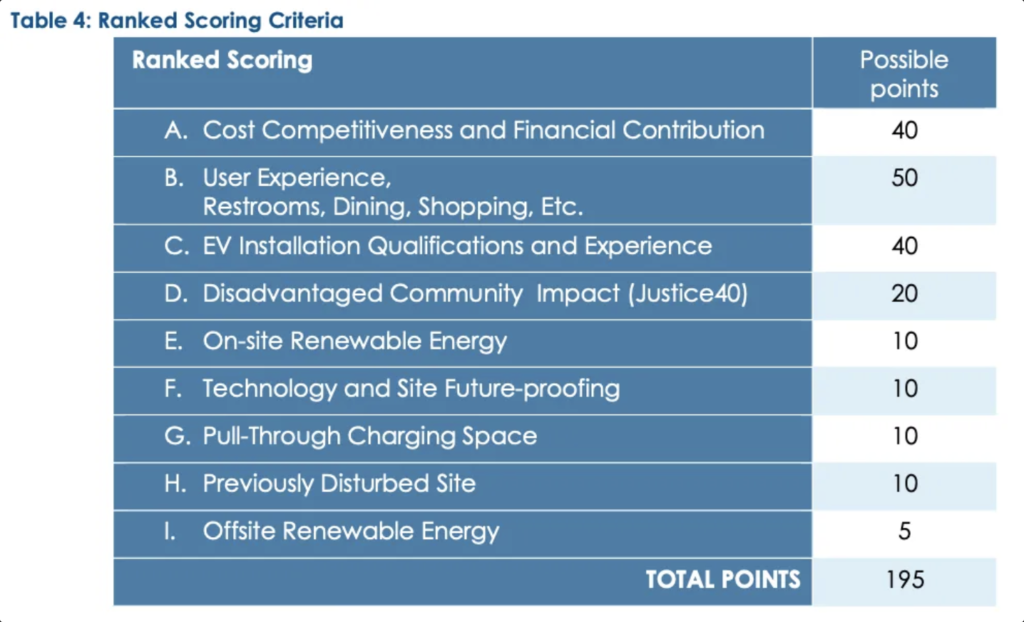
*Applicants who provide a higher financial contribution than the required 20% match will be awarded up to 15 points under the scoring criteria, increasing their chances of being approved for the award.
Eligible Expenses:
- NEVI-compliant EVSE equipment for installation at the awarded Site
- 5 years of operation, maintenance, and repair of EVSE installation equipment
- Development of Site design
- On-site traffic control devices and signage
- Data sharing with the OER
- On-site renewable energy generation and storage (ex: solar and battery).
Use of Program Income: All revenue generated from operating EV charging facilities must be allocated to:
- Debt Service: Covering project debt, reasonable reserves, and refinancing.
- Return on Investment (ROI): Providing a reasonable ROI for private financiers, as determined by the State.
- Operation and Maintenance Costs: Covering costs for improvement, operation, maintenance, and major repairs such as reconstruction or rehabilitation.
- Public-Private Partnerships: Payments owed under public-private partnership agreements, if applicable.
Award Terms: Recipients must ensure:
- A minimum of four charging ports per site, using any combination of Level 2 or DCFC devices.
- Operation, maintenance, and data reporting for a minimum of five years from the initial operational date.
Reimbursement Process:
- 90% of the grant amount will be reimbursed after project inspection and approval by the Office of Energy Resources (OER).
- 10% of the reimbursement will be retained by OER.
- 2% of the retained amount will be reimbursed annually over five years, contingent upon meeting RFA terms and grant agreement requirements, including:
- 97% uptime reliability.
- Compliance with data collection and reporting.
- Ongoing operations and maintenance support for all chargers.
- 2% of the retained amount will be reimbursed annually over five years, contingent upon meeting RFA terms and grant agreement requirements, including:
Eligibility Requirements
Eligible Applicants:
- Government Entities in Rhode Island: Includes local governments, institutions of higher education, parks, and parking areas.
- Non-Profit Organizations: Must have a physical establishment in Rhode Island.
- Tribal Organizations
- Businesses and Cooperatives: Corporations, partnerships, LLCs, or cooperatives registered, active, and in good standing with the Rhode Island Department of State.
Eligibility Requirements: Applicants must meet the following criteria:
- Site and Operation Requirements:
- Own or have control over land suitable for EVSE installation.
- Operate and maintain publicly accessible EVSE for at least 5 years post-construction.
- Availability: Charging stations must be accessible at least during the site host’s operating hours (temporary interruptions allowed).
- Payment Methods:
- Provide secure, accessible payment methods, including contactless options for debit/credit cards, toll-free phone numbers, or SMS systems.
- Prohibit membership requirements for use and ensure no restrictions based on payment method.
- Include multilingual and disability-friendly payment options.
- Technical Workforce: Installers and operators must have appropriate licenses, certifications, and training.
- Customer Support: Provide a mechanism for reporting outages or malfunctions, including multilingual services on an accessible platform.
- Federal Compliance:
- Adhere to the Build America, Buy America Act provisions
- NEVI standards outlined in the Federal Register for National Electric Vehicle Infrastructure Standards and Requirements.
- Comply with 23 CFR Part 680.
- Data Reporting:
- Quarterly Data Requirements: Submit anonymized data on:
- Charging station and port identifiers, session details, energy dispensed, peak session power by port, payment methods, port uptime, outage durations, and error codes.
- Annual Data Requirements: Report maintenance and repair costs, and participation in State or local business opportunity programs (e.g., minority-owned, veteran-owned businesses).
- To be submitted before February 1 to OER and March 1 to the FWHA.
- Quarterly Data Requirements: Submit anonymized data on:
- Financial Match:
- Provide a minimum 20% non-federal funding match.
- Cover any costs exceeding the maximum awards:
Level 2 Charger Requirements:
- Connectors: Each AC Level 2 port must have a permanently attached J1772 connector compatible with all J1772-compliant vehicles.
- Power Level:
- Each port must deliver a continuous power rating of at least 6 kW.
- Charging stations must support simultaneous power delivery of at least 6 kW per port across all AC ports.
- Power Sharing/Smart Charge Program Management: Power sharing or participating in a smart charge management program is permitted if each port meets an EV’s demand up to 6 kW, unless the EV user consents to a lower power level.
- Equipment Certification:
- Must be ENERGY STAR certified.
- Certified by an OSHA Nationally Recognized Testing Laboratory.
- Meet applicable Underwriters Laboratories (UL) standards for EV charging systems.
DCFC Charger Requirements:
- Connectors: Each DCFC port must support charging for all CCS-compliant vehicles with at least one permanently attached CCS Type 1 connector.
- Power Level: Ports must support output voltages ranging from 250 to 920 volts DC.
- Equipment Certification:
- Certified by an OSHA Nationally Recognized Testing Laboratory.
- Meet applicable Underwriters Laboratories (UL) standards for EV charging systems.
Application and Award Process
Application Deadline: Submit applications no later than 11:59 PM EST on February 28, 2025.
- Applications must be submitted through the State NEVI Application Portal: Visit here.
- Formats accepted: PDF, JPG, GIF, or PNG (up to 10MB per file). Specific file types and sizes are required for certain sections.
- Hard-copy submissions will NOT be accepted.
- OER is expected to finish reviewing application by April 1, 2025.
Application Requirements:
Applicants must submit all required attachments and worksheets found in the Application Packet.
Step-by-Step Guide for Applying:
- Determine EV Charger Types and Ports
- Choose the type of EV chargers (Level 2 or DCFC) and determine the number of ports.
- Each location must include a minimum of 4 ports to be eligible for funding.
- Evaluate the Proposed Location
- Ensure the site is located on a public road or in a publicly accessible area.
- Evaluate for key site attributes:
- Parking spaces, ADA accessibility, and electrical power availability.
- Prepare and Submit Application
- Complete all sections of the application and include the required permits.
- Ensure all forms, including the Utility Form, are signed and submitted.
- If Approved, Coordinate Implementation
- Awardees must work with their utility and Rhode Island Energy to:
- Finalize and submit the Site Plan.
- Fill out and submit a Work Order Request (Attachment O – guidance document).
- Begin construction and meet all NEVI program guidelines for installation, operation, and reporting.
- Awardees must work with their utility and Rhode Island Energy to:
Steps for Electrical Evaluation and Coordination:
- Coordinate with Rhode Island Energy:
- Confirm utility connection feasibility based on load and demand needs.
- Complete the Utility Form (Attachment G) in the guidance document. The form must be signed by Rhode Island Energy to confirm the site is within their service territory and supports the necessary utility connection.
Electrical and Site Preparation:
- Determine amperage, voltage, and service size per the National Electrical Code (NEC).
- Specify service type and characteristics. Submit a work request to RI Energy for new or upgraded service (Attachment O – guidance document).
- Develop a Site Plan that includes:
- EV charger placement, parking spaces, signage, and electrical connection details.
- For services of 400 amps or greater, include a one-line diagram showing:
- Service voltage and main switch rating(s).
- Primary overcurrent device(s), conductor specifications, conduit details, and utility billing meter locations.
Regulatory and Environmental Compliance:
- Review location for:
- Zoning ordinances, easements, parcel IDs, flood zones, city council boundaries, and watersheds.
- Confirm compliance with the National Environmental Protection Act (NEPA). Sites must qualify for a One-Time Programmatic Categorical Exclusion.
- Identify and apply for local permits and licenses required for installing, owning, and operating EVSE.
- Familiarize yourself with NEVI Phase II requirements, including installation, operations, maintenance, and data reporting guidelines (Guidance document).